Inkblots, Imagination, and Culture
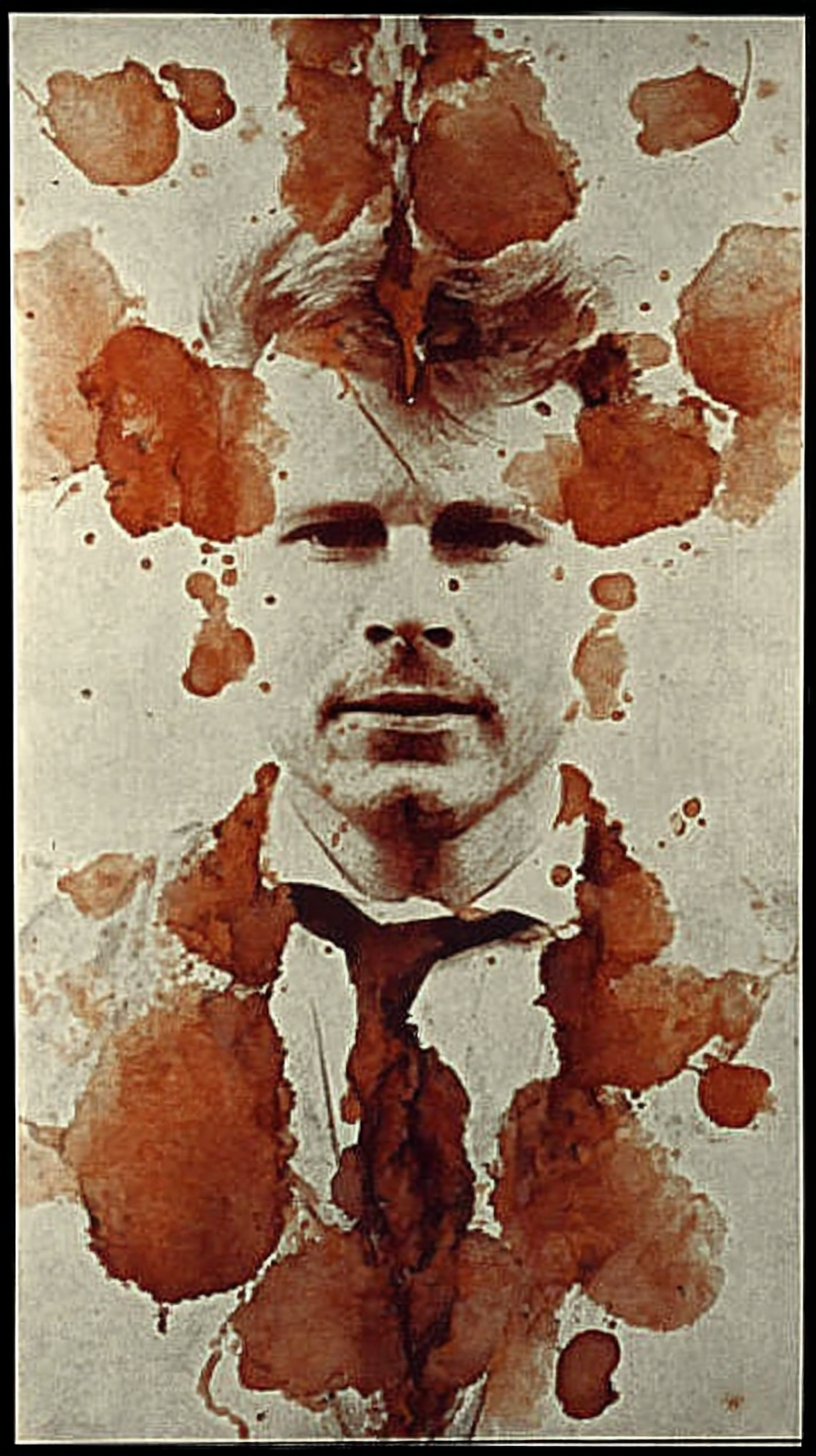
A Simple Question That Travelled the World
"What do you see?"
It's such a small question. Almost throwaway. But over the last century, it's become one of the most recognisable prompts in modern culture.
From books and films to graphic novels and fashion editorials, the inkblot has taken on a life of its own — shifting from an obscure curiosity into a symbol of self-reflection, mystery, and perception.
And like most things that stick around this long, its story is more interesting than you might expect.
Where It All Began
The origin of the inkblot goes back to the early 20th century, when a Swiss thinker named Hermann Rorschach started experimenting with ambiguous images. He wasn't the first to notice that people saw different things in abstract shapes — that idea had been floating around in art and philosophy for years. Leonardo da Vinci used a form of projective technique with his apprentices, testing whether they could look at a blank, complex, or natural form and project their own understanding of anatomy, light, and shadow onto the page. Rorschach was the one who turned it into something structured and repeatable.
What fascinated him wasn't the ink itself, but the variation in responses. Give the same image to ten people, and you'd get ten completely different interpretations. Some saw animals, others saw people, others saw movement or emotion.
It raised a compelling idea: maybe the way we interpret the world says as much about us as the world itself.
That idea stuck.


From Paper to Pop Culture
It didn't take long for inkblots to escape their original context and enter mainstream culture. There's something inherently cinematic about them — symmetrical, abstract, slightly unsettling. They invite curiosity in a way that feels both playful and profound.
You've probably seen them referenced without even thinking about it. In films, they often appear in moments of introspection or tension, where characters are asked to reveal something about themselves without realising it. The inkblot becomes a kind of narrative shortcut — a way to show inner complexity without spelling it out.
One of the most iconic examples is the character Rorschach from the graphic novel Watchmen. His shifting inkblot mask reflects his worldview — constantly changing, impossible to pin down, shaped by perception rather than fixed reality. It's not just a visual choice; it's a statement about identity and interpretation.
That same visual language shows up across media. Inkblots appear in psychological thrillers, abstract art, album covers, and even high-fashion photography. They've become shorthand for depth, ambiguity, and the idea that meaning isn't always obvious.
Why Inkblots Work So Well in Storytelling
There's a reason inkblots keep reappearing in creative spaces.
They do something most visuals don't: they require participation.
A photograph shows you something specific. A painting might guide your interpretation. But an inkblot leaves the door wide open. It asks you to complete it.
That makes it incredibly powerful in storytelling. Instead of telling you what something means, it invites you to decide. And in doing so, it pulls you deeper into the experience.
Writers and filmmakers have used this for decades. An inkblot can signal uncertainty, duality, or hidden layers without a single line of dialogue. It creates a moment where the audience becomes part of the story — projecting meaning, just like the character on screen.
Inkblots in a Visual World
Fast forward to today, and we live in a world saturated with images. Everything is curated, filtered, optimised.
And yet, the inkblot still stands out.
Why? Because it resists definition.
In a digital landscape where everything is labelled and categorised, an inkblot feels almost rebellious. It doesn't tell you what it is. It doesn't guide your interpretation. It simply exists — waiting for you to make sense of it.
That's part of its appeal in modern culture. It offers a rare pause. A moment where you're not consuming content, but interacting with it.
The Inkblot as Identity
Over time, inkblots have come to represent something bigger than their original purpose. They've become a symbol of identity — not fixed, but fluid.
You can see this in the way they're used visually. Designers play with symmetry and abstraction to create pieces that feel personal yet universal. Artists use inkblots to explore themes of duality, contradiction, and transformation.
There's a tension in every inkblot: what's hidden, what's shown, and how perception fills the gap. That tension is exactly what makes them so compelling.


A Cultural Shortcut to Self-Discovery
In many ways, inkblots have become a cultural shortcut for self-reflection.
Not in a heavy or serious way — more like a moment of curiosity. A pause in the noise. A chance to notice something about how you think.
That's why they've endured. They're simple, but not shallow. Open-ended, but not meaningless.
You don't need context or background knowledge. You just need a few seconds and a willingness to look.
Why We Keep Coming Back to Them
There's something timeless about the idea that meaning isn't fixed — that it emerges through perception.
Inkblots capture that idea perfectly.
They remind us that two people can see the same thing and experience it completely differently. That interpretation is shaped by perspective. That ambiguity isn't something to avoid, but something to explore.
In a world that often pushes for certainty and quick answers, that's a refreshing shift.
A Modern Take on an Old Idea
What's interesting now is how this classic idea is being reimagined.
Instead of static images on paper, inkblots are becoming interactive, digital, and accessible. You can engage with them anywhere — on your phone, in a moment of downtime, without any setup or expectation.
The experience becomes less about the ink itself and more about the interaction. What you notice. What you say. What patterns start to emerge over time.
It's less about finding an answer and more about enjoying the process of looking.
A Final Thought
Inkblots have travelled a long way — from early experiments to cultural icons, from paper cards to digital experiences. But at their core, they've stayed the same.
They ask you to look, and then to notice how you look.
ReadMyBlot is designed as an entertainment and self-reflection experience, not a clinical tool. It draws on themes from established psychological traditions — projective storytelling, the Big Five, and emotional intelligence — but applies them as a narrative framework rather than a validated instrument. The value isn't in a score or a label, but in the reflection it invites.
And sometimes, all it takes is a single question — what do you see? — to start that conversation.
Curious what the ink reveals about you?
Take the Inkblot Test10 cards · 15 minutes · one portrait as unique as you